CDL Practice Written Test
DMV Written TestEducation
4.6401.00 Reviews
- Version
- 2.2.4
- Installs
- 100.00K
- Age Rating
- Everyone
Screenshots
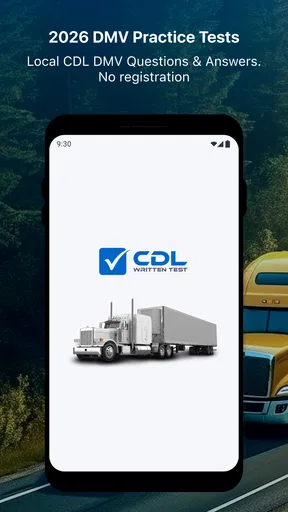
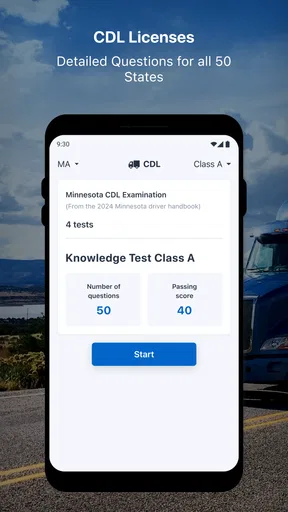
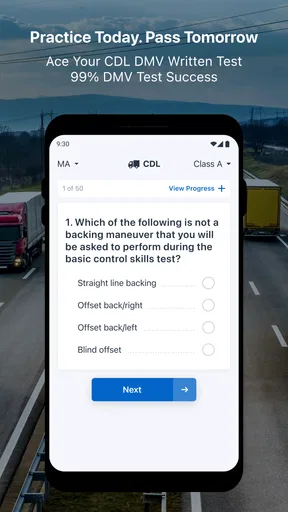
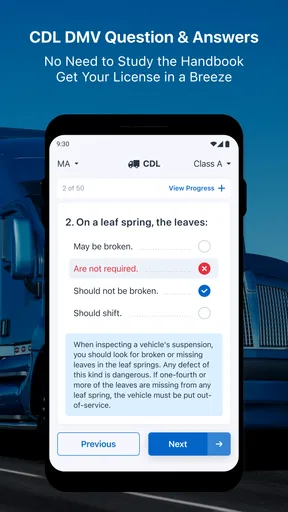
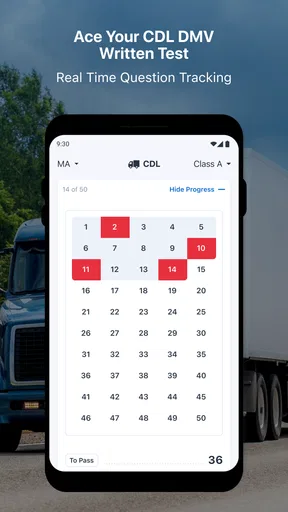
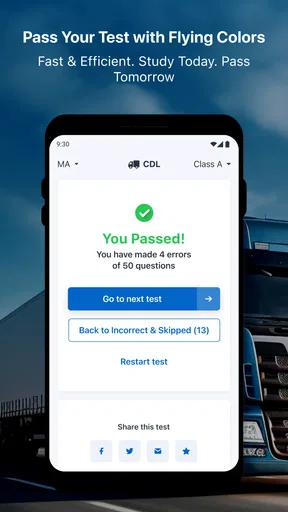
Our Review of CDL Practice Written Test
 Analysis by Appyee
Preparing for a commercial driver’s license written exam can feel less like studying and more like trying to organize a pile of rules, signs, safety procedures, and vehicle knowledge into something you can actually recall under pressure. CDL Practice Written Test takes a focused approach: it is an education app built around practice for the CDL written exam, with material intended for drivers working toward requirements in different states. I found its main appeal in the way it turns spare moments into short study sessions instead of asking you to sit down with a large manual every time.
The app is free, rated for Everyone, and comes from the developer DMV Written Test. It has reached over 100 thousand installs and holds a 4.6 average from around 4.5 thousand ratings, which suggests that it has found a useful place among people looking for an accessible study companion. That popularity should not be mistaken for a guarantee that it will replace official preparation, though. My view is that it works best as a practice layer: something you use to identify weak areas, build familiarity with question wording, and decide what deserves another careful reading in your state’s official handbook.
How the practice experience feels in everyday use
I find the most useful way to approach these practice sessions is to treat each one as a check on what I can explain, not just what I can recognize. That small shift helps keep familiar answer patterns from feeling like mastery and makes it easier to decide when to pause and consult the handbook. It also sets up a closer look at how a focused practice routine can fit around the rest of a learner’s day.
Quick sessions are where the app makes the most sense
When I use a test-preparation app, I want to reach a useful question quickly. CDL Practice Written Test is most attractive in that situation. Rather than treating study as a long academic session, it gives the experience of answering practice questions and checking whether I understand the reasoning behind them. That makes it suitable for a lunch break, a quiet period before work, or the final part of an evening when I do not have the attention for a full chapter.
The perceived speed of an app like this matters because hesitation between questions can break concentration. In my experience, the simple practice-test format feels more direct than browsing a large document and manually deciding what to review next. I can focus on the question in front of me, make a choice, and use the result to guide the next step. That does not make the learning effortless, but it reduces the amount of time spent managing the study process itself.
A realistic routine would be a new driver commuting by public transport after work. Instead of trying to read the entire CDL manual on a crowded ride, they could complete a short practice session, note the topics that repeatedly cause mistakes, and return to the handbook later with a more precise goal. The app is especially useful in that workflow because practice exposes uncertainty faster than passive reading. If I keep choosing the wrong answer on a safety-related question, I know exactly what deserves attention.
What happens when study becomes intensive
The app becomes more valuable when used repeatedly, but heavy use also reveals its limits. A practice tool can encourage a false sense of progress if I measure success only by remembering familiar questions. I therefore prefer to vary my sessions: one round for broad coverage, another focused on errors, and a later round after I have reviewed the underlying rule elsewhere. This turns the app from a guessing exercise into a basic feedback system.
During a concentrated study period, the most important resource is not raw screen performance but mental stamina. Repeating tests for too long can make answers feel familiar without proving that I understand them. I would rather complete several focused sessions with pauses than rush through a large number of questions and remember only the position of the correct option. The app supports this kind of flexible use, but the discipline has to come from the learner.
Resource demands should also be viewed realistically. Because this is a dedicated education app rather than a visually elaborate game, I would expect ordinary study use to be less demanding than media-heavy applications. Still, the practical experience can depend on the phone, the operating system, available storage, and whatever else is running in the background. The current version is 2.2.4 and requires Android 6.0 or later, so people using older Android devices should check compatibility before planning their entire study routine around it.
Building a study loop instead of tapping randomly
One of the more useful ways to approach the app is to divide practice into three passes. First, answer without looking anything up. Second, review every mistake, including questions where the answer was a lucky guess. Third, return to the official material and confirm the rule in context. This matters for CDL preparation because a correct option on a practice screen is not enough if I cannot explain why the other choices are unsafe or incorrect.
I also recommend keeping a small list of recurring trouble spots outside the app. That list might include vehicle inspection details, braking concepts, or terminology that sounds similar but has different consequences. The app can reveal patterns in my errors, while handwritten notes or a separate document help prevent those patterns from disappearing when I start another test. This is a simple workflow, but it gives the practice sessions a purpose beyond collecting high scores.
Another practical tip is to avoid using the app only when the exam is close. Short, regular exposure is better for recognizing the style of questions and identifying vocabulary that initially feels unfamiliar. If I wait until the last evening, the app may show me what I do not know, but there will be little time to repair those gaps properly. Used earlier, it becomes a diagnostic tool rather than an emergency cramming tool.
Reliability depends on how you verify what you learn
I would describe the app as a useful preparation aid, not the final authority for licensing requirements. CDL rules and testing expectations can be tied to the state where the exam takes place, and a general practice experience cannot remove the need to consult the relevant official handbook. The app’s emphasis on tests for all states is helpful for broad preparation, but I would still compare important details with current state materials before the exam.
That distinction is especially important for someone changing jurisdictions, adding an endorsement, or preparing for a specific commercial vehicle category. A question that feels broadly relevant may still leave out the exact wording or local emphasis that appears in an official test. I would use the app to strengthen recall and expose weak knowledge, then use state documentation to settle questions where precision matters.
Reliability also includes recovery from mistakes. A good study session should not collapse because I miss several questions in a row. I found the most productive response is to treat wrong answers as a queue for review rather than as a judgment on readiness. After a difficult session, I would stop repeating the same test immediately, read the relevant material, and return later. This approach prevents frustration from turning into blind memorization.
For users concerned about stability, a straightforward practice app has an advantage over a more elaborate learning platform: there are fewer layers competing for attention. That said, no mobile app is immune to interruptions, device-specific issues, or an unexpected restart. I would avoid relying on it as the only resource during the final hours before an exam. Keep the official handbook available, and make sure important notes exist somewhere outside the app so a technical problem does not erase your preparation plan.
Phone limitations and accessibility in real situations
A phone is convenient, but it is not always the ideal study surface. On a smaller display, long question wording can require more scrolling and concentration, particularly for someone with tired eyes or limited time. A larger phone or tablet may make reading more comfortable, while a quiet environment can matter more than screen size when questions involve several conditions at once.
People who need highly structured accessibility support should test the app during a normal study session rather than assuming every device will present text in the same way. System text settings, screen readers, contrast preferences, and touch sensitivity can change the experience. The important question is whether the interface remains comfortable enough for repeated reading, because CDL preparation often involves returning to similar concepts many times.
Older hardware may also affect perceived responsiveness, especially if storage is nearly full or many applications are active. The Android requirement of version 6.0 or newer makes the app available to a broad range of devices, but compatibility alone does not guarantee an equally smooth experience on every phone. If the app feels slow, I would first close background applications, restart the device, and make sure there is enough free space before deciding that the problem is permanent.
There is another constraint that is easy to overlook: attention. Studying in a vehicle, at a fuel stop, or during a noisy break may be convenient, but it can also encourage rushed answers. I would never treat a practice session as something to do while driving or handling equipment. The best use is stationary and deliberate, even if the session lasts only a few minutes.
Who will benefit most from this particular approach
This app is a strong fit for a first-time CDL candidate who already has access to the official study material but wants more active recall. It is also useful for a driver returning to preparation after a long gap, someone who wants to rebuild confidence before booking an exam, or a learner who finds passive reading difficult. The free price removes a common barrier, so trying it alongside a handbook is easy rather than a major commitment.
It can also help experienced drivers who know the practical side of operating a vehicle but need to refresh formal test knowledge. Practical experience and written-exam performance are not identical. A person may be comfortable with daily driving and still stumble over terminology, inspection sequences, or the exact logic behind a safety question. Short practice sessions can expose those gaps without requiring a complete restart from the beginning.
I would be more cautious recommending it to someone who wants a single complete course with instructor explanations, progress coaching, or a guaranteed state-specific study path. A practice-test app is not the same as guided instruction. If I repeatedly miss a concept and need a teacher to explain it in different ways, a classroom, driving school, or structured course may be the better investment. The app can show the symptom, but it may not provide all the teaching needed to cure it.
It is also not the right choice for anyone who plans to memorize answer patterns without understanding commercial driving principles. That strategy may produce temporary confidence but leaves the learner vulnerable when wording changes. The strongest results come from treating each question as a prompt to explain a rule, not as a flashcard with a fixed position.
How it compares with manuals, classes, and broader test apps
The official CDL handbook remains better for complete explanations, legal wording, diagrams, and state-specific reference. Its weakness is that reading does not always reveal what I have failed to remember. CDL Practice Written Test fills that gap by forcing retrieval. I can read a section in the handbook and feel comfortable, then discover through questions that I cannot apply the idea without help.
Compared with a classroom or instructor-led course, the app is more flexible and less personal. I can practice whenever I have time, but I cannot ask it to rephrase a confusing concept or observe how I reason through a problem. A teacher is better when the difficulty is conceptual or when I need feedback on a broader preparation plan. The app is better for repetition, quick checks, and maintaining momentum between lessons.
Compared with a general quiz application, this one has the advantage of being centered on CDL written preparation rather than broad trivia or generic driving questions. That focus makes each session more relevant to the learner’s goal. The trade-off is that the experience is narrower: people looking for interactive driving simulations, behind-the-wheel coaching, or a full career-learning platform should look elsewhere.
The free model is another practical difference. It makes experimentation straightforward, especially for users who are unsure whether practice questions suit their learning style. I would still judge its value by whether my mistakes become less frequent and my explanations become clearer, not simply by how many sessions I complete. Free access is helpful, but effective preparation still requires time with authoritative material.
My performance verdict after weighing speed and recovery
My overall impression is that CDL Practice Written Test succeeds because it keeps the central task visible: answer questions, find weak spots, and practice again. It feels most effective when I use it in short, intentional sessions and connect every mistake to a section of the official handbook. The experience should be manageable on supported Android devices, although older phones, crowded storage, small screens, and distracted environments can reduce comfort.
The app’s strongest performance trait is not flashy presentation; it is the low friction between deciding to study and beginning a practice round. That matters for busy learners who may postpone preparation if every session requires too much setup. Its main weakness is the risk of mistaking repetition for mastery. Without review and state-specific verification, a high result can be reassuring without being meaningful.
Released on May 23, 2024, and currently offered free for Everyone, it is an easy tool to add to a broader preparation plan. The developer DMV Written Test has positioned it clearly as an education app for CDL practice, and the current version gives Android users on version 6.0 or later a practical way to try that approach. I would recommend it to a friend who wants extra testing practice, provided they understand its role.
My final recommendation is to use CDL Practice Written Test as a daily checkpoint, not as your only source of truth. Start with the official state material, use the app to challenge your recall, record the subjects that cause repeated mistakes, and return to the source until you can explain the answer in your own words. For a free, focused study companion, that combination gives the app a sensible place in a serious CDL preparation routine.
Verdict
Strengths of CDL Practice Written Test
- Covers key topics found in official CDL written exams.
- Practice questions help identify weak areas before test day.
- Simple interface makes short study sessions convenient.
- Useful for reviewing while commuting or during spare moments.
- Suitable for beginners and drivers refreshing their knowledge.
Limitations of CDL Practice Written Test
- Some questions may differ from your state's exact exam wording.
- Full preparation may require studying an official CDL manual too.
- Explanations can be limited for users needing deeper instruction.
- Practice tests may feel repetitive after several attempts.
- Features and question coverage may vary between app versions.
Other Releases by DMV Written Test
View All
Driver Written Test: 2026 Test
Education4.7
Similar Picks in This Category
View All
Duolingo: Language Lessons
Duolingo4.7

Google Classroom
Google LLC2.8

Unacademy: Learn & Crack Exams
Unacademy3.2

Bible App for Kids
Life.Church4.4

Cake - Learn English & Korean
Cake Corp.4.7

Brainly: AI Homework Helper
Brainly4.5
Frequently Asked Questions
What is CDL Practice Written Test?
CDL Practice Written Test is a study and preparation app designed for people working toward a Commercial Driver’s License. It provides practice questions based on common written-test topics, including general knowledge, air brakes, combination vehicles, hazardous materials, and other endorsements. The app is intended to help users review important concepts and become familiar with the format and difficulty of questions they may encounter.
Can CDL Practice Written Test replace an official driving school or state handbook?
No. CDL Practice Written Test should be used as a supplementary study tool rather than a complete replacement for your state’s official CDL manual, professional instruction, or a certified driving school. Licensing rules, test questions, endorsements, and eligibility requirements can vary by state. Before taking the exam, compare the app’s material with the latest handbook issued by your local Department of Motor Vehicles or equivalent licensing authority.
Which CDL subjects and endorsements can I study with the app?
The available subjects depend on the version of the app, but CDL practice platforms commonly cover general commercial driving knowledge, vehicle inspection, safe operation, air brakes, combination vehicles, passenger vehicles, tank vehicles, doubles and triples, school buses, and hazardous materials. Check the app’s topic list before downloading to confirm that it includes the specific class or endorsement you need.
Does CDL Practice Written Test work offline?
Many practice-test features may be available without a continuous internet connection after the app has been installed, which can be useful when studying during breaks or while traveling. However, certain functions—such as advertisements, updates, synchronization, analytics, or additional content—may require internet access. It is a good idea to open the app once while connected and verify which quizzes and explanations remain accessible offline.
Is CDL Practice Written Test free to download and use?
The app may be free to download, but some versions can include advertisements, optional purchases, subscriptions, or locked question sets. The exact pricing and available features may differ between Android and iOS and can change over time. Review the store listing and in-app purchase details before starting a subscription. Also remember that passing the practice quizzes does not guarantee success on the official CDL written examination.
